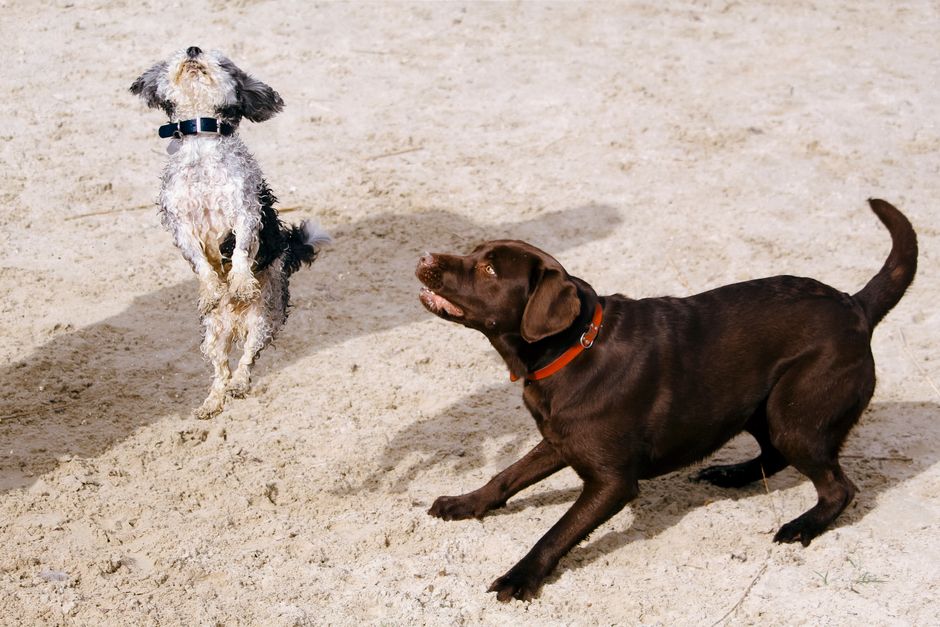
Jumping up happens because, from a dog's point of view, it's a highly effective way to greet someone: it gets them closer to a person's face and hands, and in a dog's early life it very often worked, since small puppies jumping on people usually got picked up, petted, or laughed at. The behavior isn't about dominance or testing you — it's simple excitement paired with a strategy that's been rewarded, sometimes for years, by well-meaning people. Fixing it means making the rewarded path change: calm greetings get the attention, jumping gets none.
Why Jumping Keeps Happening
Every time a jumping dog gets touched, talked to, or even pushed away with hands (which still counts as contact and attention to most dogs), the behavior gets reinforced again. Visitors are usually the hardest variable to control, since many people enjoy an enthusiastic greeting and don't realize that petting a jumping dog undoes the owner's training in a few seconds. Consistency across everyone the dog meets is what actually changes the pattern — one inconsistent greeter can slow the whole process.
The Core Training Protocol
- Decide on the behavior you want instead — sitting, or simply standing with four paws on the floor — before you start training.
- Practice calm approaches at low excitement first: walk toward your dog and stop approaching the instant paws leave the ground, then continue only once they're back down.
- Reward the moment all four paws are on the floor, every single time, with calm praise or a treat delivered low, near the dog's chest height.
- Increase difficulty gradually: practice with you entering the room, then with a familiar visitor, then with a more exciting guest.
- Ask every visitor in advance to ignore the dog completely — no eye contact, no talking, no touching — until four paws are down and calm.
- Give your dog a job during greetings, such as going to a mat or holding a toy, which makes jumping physically harder to do at the same time.
Managing the Moment, Not Just Training It
While training is underway, a leash indoors during greetings, a baby gate at the door, or asking your dog to wait in another room until visitors are settled all prevent jumping from being rehearsed and rewarded by accident. Management isn't a failure of training — it buys time for the new, calmer greeting pattern to become the stronger habit. The same logic applies to other impulse-control issues like leash pulling, where blocking the chance to rehearse the old pattern speeds up the new one.
Greeting Protocol by Scenario
| Scenario | What to do |
|---|---|
| You arrive home | Keep your own greeting low-key; wait for calm before petting |
| A familiar visitor arrives | Leash the dog, ask the visitor to wait for four paws down |
| A stranger on a walk approaches | Ask them not to pet until your dog is sitting calmly |
| Kids want to greet the dog | Have the dog sit first; supervise closely regardless |
Jumping in Puppies vs. Adult Dogs
Puppies often start jumping simply because they're small and jumping is the most direct way to reach a face that's otherwise far away; it can look endearing at eight weeks old and feel very different at eight months, once the dog has grown into a much bigger body. The earlier a consistent four-paws-on-the-floor rule is introduced, the less there is to undo later, since a behavior that's been rewarded for months becomes a stronger habit than one caught early. Adult dogs who jump, especially ones adopted as adults, may be carrying years of reinforced greeting history from a previous home, which simply means the retraining process may take a bit more repetition, not that it won't work.
Size and Safety Considerations
With larger dogs, jumping carries real safety concerns — a sixty-pound dog landing on a small child, an elderly visitor, or someone with balance issues can cause an injury even when the jump is entirely friendly in intent. This makes consistent management especially important for bigger breeds while training is underway: a leash held during greetings, a gate at the entryway, or a few minutes in another room while guests settle in all reduce risk without requiring punishment. Smaller dogs are not exempt from training either; jumping that's "cute" at ten pounds still represents the same excitement-driven pattern and benefits from the same clear, consistent response.
Common Mistakes
- Petting a jumping dog "just this once." Any inconsistency resets progress because the behavior still worked that time.
- Pushing the dog away with hands. Physical contact, even when meant as correction, can still read as a reward to an excited dog.
- Kneeing or stepping toward the dog sharply. This can startle or frighten a dog without teaching the greeting you actually want.
- Only training with family, never with visitors. Dogs don't automatically generalize a skill to new, more exciting people.
- Yelling during greetings. Raised voices add to the arousal that's already driving the jumping.
- Giving up after one setback. A single relapse with an inconsistent guest doesn't erase earlier progress if you get back to the plan.
Frequently Asked Questions
Is jumping a sign of dominance?
No. Jumping is driven by excitement and a learned history of getting attention that way, not by a dog trying to assert status over people.
How long does it take to stop a dog from jumping?
With consistent practice across everyone the dog greets, many dogs show real improvement within two to four weeks, though full reliability with excited visitors can take longer.
What if my dog only jumps on certain people?
That usually points to which people have (even accidentally) rewarded the jumping with attention. Getting those specific people to follow the same protocol closes the gap.
Should I use a shock collar for persistent jumping?
No. Jumping responds well to reward-based training that gives the dog an alternative behavior; aversive tools aren't needed and can create unrelated fear or anxiety.
Sources
- American Kennel Club (AKC) — guidance on teaching polite greetings and managing visitor interactions.
- ASPCA — resources on reward-based approaches to common greeting behaviors.
- CCPDT (Certified Council for Professional Dog Trainers) — standards supporting force-free training methods for everyday behaviors like jumping.