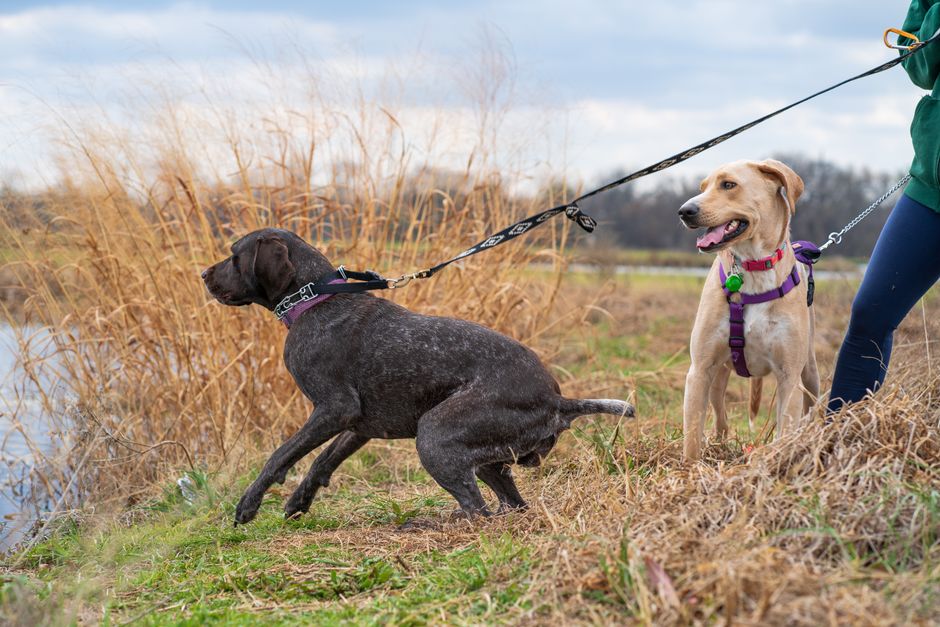
Dogs don't pull on the leash to challenge their owners — they pull because walking faster toward something interesting has, in almost every past walk, gotten them there sooner. The leash itself doesn't mean anything to a dog until they're taught what tension on it should predict, so without training, the natural strategy is simple: lean into the pressure, move forward, arrive at the interesting smell or person a few seconds earlier. That small success, repeated over hundreds of walks, is enough to build a strong, automatic pulling habit that has nothing to do with stubbornness.
The Reinforcement Loop Behind Pulling
Every walk where pulling moves a dog closer to a destination reinforces pulling as the winning strategy, even if you eventually stop and wait. If stopping only delays the forward motion rather than truly ending it, dogs quickly learn that pulling still pays off, just a little slower. Reversing the habit means making loose-leash walking the only strategy that reliably produces forward movement, consistently, from the very first step of every walk.
Equipment That Supports Training
| Equipment | How it helps |
|---|---|
| Front-clip harness | Redirects forward pulling without pressure on the neck |
| Standard flat collar or back-clip harness | Fine once pulling is mostly resolved; less helpful during early training |
| Standard 4–6 ft leash | Gives enough slack for a loose-leash cue without excess length to manage |
| Treat pouch | Keeps rewards accessible for fast, well-timed reinforcement |
Retractable leashes make loose-leash training harder because the constant light tension doesn't clearly signal anything, and prong or shock collars are not recommended: they rely on discomfort to suppress pulling rather than teaching a dog what to do instead, and they can create new tension or fear around walks.
A Step-by-Step Training Plan
- Start in a low-distraction space, like your yard or a quiet hallway, before taking the method outside.
- The instant your dog moves ahead and tension appears on the leash, stop walking completely and wait silently.
- The moment the leash goes slack again, even briefly, mark it and reward, then resume walking.
- Reward generously for position near your side, especially right after a turn or distraction, when drifting ahead is most likely.
- Practice short "engage-disengage" games near mild distractions: reward your dog for looking at something and then back at you.
- Gradually extend the distance and increase distraction level only once the current level is consistently loose.
Reading Your Dog's Motivation
Pulling toward a specific smell, another dog, or a person usually reflects simple excitement and a strong reinforcement history, and responds well to the stop-and-reward method above. Pulling that comes with stiff body language, barking, or lunging toward a trigger is a different problem — that pattern often points to fear-based reactivity rather than ordinary excitement, and benefits from a distance-based approach instead of just loose-leash mechanics.
Keeping Walks Rewarding Without the Pulling
Dogs pull harder when a walk is the only outlet they get for sniffing and exploring all day, so building in deliberate "sniff breaks" on a loose leash, where your dog is allowed to explore slowly on cue, reduces the urgency behind pulling toward every new smell. Pairing this with structured decompression time at home — the same principle used for other high-arousal behaviors like attention-seeking habits — tends to make the whole walk calmer.
Pulling Toward Specific Destinations
Some of the most stubborn pulling happens in the last few feet before a strongly anticipated destination, like the door to the dog park or a favorite neighbor's yard. Dogs learn the route itself, not just the general act of walking, so the pulling often intensifies in exactly the spots where the payoff has historically been biggest. Changing the route occasionally, or practicing extra loose-leash repetitions specifically in that stretch, helps prevent one location from becoming an exception to the rest of your otherwise successful training.
Building the Habit Over Multiple Walks
Loose-leash walking is easiest to build if every walk, not just dedicated "training walks," follows the same stop-and-reward rule from the first few steps out the door. Dogs generalize faster when the rule is consistent across contexts — the driveway, the sidewalk, the park — rather than only enforced during a short formal session each day. Short, frequent practice across ordinary daily walks tends to produce more durable results than occasional long sessions.
Common Mistakes
- Letting pulling work "just this once." A single walk where pulling gets your dog somewhere faster undoes several days of consistent stopping.
- Yanking the leash back. This adds discomfort without teaching your dog what to do differently next time.
- Using a retractable leash during training. The constant light tension makes it hard for your dog to feel the difference between loose and pulling.
- Only practicing in calm settings. Dogs don't automatically transfer a skill learned at home to a busy sidewalk without separate practice.
- Expecting instant results. Years of reinforced pulling usually take weeks of consistent practice to reverse, not a single walk.
- Treating all pulling the same way. Excitement-based pulling and fear-based lunging need different responses, not one universal fix.
Frequently Asked Questions
Will a harness alone stop the pulling?
A harness changes where pressure lands and makes pulling less uncomfortable for the dog's neck, but it doesn't teach loose-leash walking by itself — training is still needed.
How long does loose-leash training take?
Many dogs show noticeable improvement within two to four weeks of consistent, short daily practice, though full reliability around high distractions can take longer.
Is it okay to let my dog pull toward the dog park?
It's best to avoid it, since even occasional successful pulling toward a high-value destination reinforces the habit broadly, not just for that one spot.
My dog pulls and barks at other dogs — is that the same issue?
Not exactly. Pulling paired with barking or lunging at other dogs often reflects fear or overarousal rather than simple excitement, and is covered more directly in our guide to fear-based reactivity.
Sources
- American Kennel Club (AKC) — guidance on loose-leash walking techniques and equipment choices.
- ASPCA — resources on reward-based leash training methods.
- American Veterinary Society of Animal Behavior (AVSAB) — position statements against aversive leash tools such as prong and shock collars.