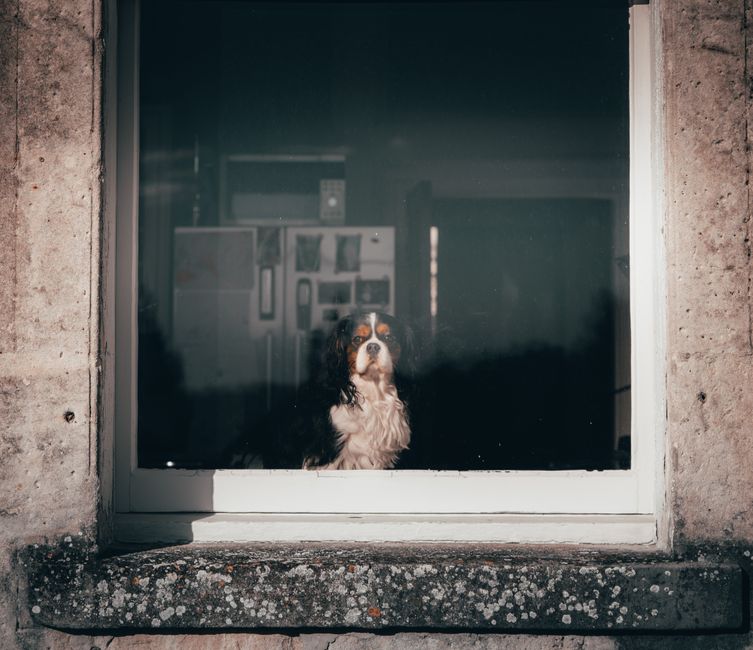
Dogs are a social species that evolved alongside humans to form close attachments, so for many dogs, being left alone isn't neutral — it registers as the loss of safety. Separation anxiety happens when that normal attachment tips into genuine distress: a spike in stress hormones, a racing heart, and a brain that can't settle until the person returns. Understanding that this is a panic response, not defiance or a bid for attention, changes how you respond to it. The goal isn't to make the dog "get over it" through exposure alone; it's to rebuild their sense that alone time is safe, in small enough steps that they never have to panic to learn it.
What Separation Anxiety Really Looks Like
True separation anxiety is specific: it happens only (or mostly) when the dog is isolated from a particular person or persons, it starts within minutes of departure, and it looks like panic rather than mischief — frantic scratching at doors, howling or non-stop barking, trembling, drooling, or attempts to escape that can cause self-injury. Some dogs refuse food left for them, which is a strong tell, since a relaxed dog will usually eat.
Not every alone-time problem is anxiety
A dog who chews a shoe, digs in the trash, or barks at passing delivery trucks while you're out may simply be bored, under-exercised, or reacting to an outside trigger — not panicking about your absence. The clearest way to tell the difference is to record your dog on a phone or pet camera during a short absence. Anxiety shows up almost immediately and continuously; boredom-driven behavior tends to be intermittent and often starts later in the absence.
Common Triggers and Risk Factors
Separation anxiety can appear after a change in routine or household composition: a move, a new work schedule, the loss of a companion animal or person, or adoption itself, since many rescue dogs have already experienced at least one loss of attachment. It's also more common in dogs who have rarely practiced being alone, including puppies raised with constant company and dogs adopted during periods when owners were home all day. None of this means the dog is "ruined" — it means the skill of being comfortably alone was never built, and it can still be built now.
Building Independence Gradually
The core tool for real separation anxiety is systematic desensitization: exposing your dog to being alone in doses so small they never trigger panic, then slowly increasing the duration as comfort grows. This is slower than most owners expect, and that's the point — rushing it undoes progress.
- Start with the door closed but you still in the home, for a few seconds at a time, rewarding calm.
- Practice your normal departure cues (keys, shoes, coat) separately from actually leaving, so they stop predicting panic.
- Step outside for 5–10 seconds, return calmly before any distress begins, and repeat several times a day.
- Increase duration in small increments — seconds, then minutes — only after your dog is relaxed at the current level.
- Once your dog tolerates 30–40 minutes calmly, longer absences usually become easier to extend.
- Keep sessions separate from real departures you can't control yet; use a sitter or daycare for those in the meantime.
Short-Term Management While You Train
While desensitization is underway, you still need a plan for the absences that have to happen. Management doesn't fix anxiety on its own, but it prevents your dog from rehearsing panic and prevents backslides.
| Tool | What it does | Caution |
|---|---|---|
| Daycare or a trusted sitter | Avoids solo absences during training | Choose a calm environment, not an overstimulating one |
| Food puzzle or stuffed toy | Gives a calm activity near departure | Won't resolve panic-level anxiety alone |
| Pet camera | Lets you confirm real distress levels | Use it to inform training, not just to watch |
| Veterinary consultation | Rules out medical causes, discusses anti-anxiety support | Medication supports training, it doesn't replace it |
Enrichment and Routine Support
A tired, mentally satisfied dog settles faster, so a solid walk, sniff time, or short training session before you leave helps — but enrichment alone will not resolve true separation anxiety, because the issue is the absence of a person, not a lack of stimulation. Keep departures and returns low-key: an excited reunion can accidentally teach your dog that your return is the big event to anticipate, which raises arousal around the whole cycle. Related issues like excessive barking and destructive chewing often overlap with alone-time distress, so it's worth ruling those causes in or out too.
Common Mistakes
- Jumping straight to long absences. Leaving for a full workday before your dog tolerates ten minutes guarantees a panic rehearsal that sets training back.
- Making a big deal of goodbyes and hellos. Emotional departures and arrivals raise your dog's arousal around the very transition you're trying to calm.
- Assuming it will resolve on its own. Without a plan, most dogs don't habituate to being alone; the panic response often gets more entrenched.
- Punishing the aftermath. Scolding a dog for chewed furniture or accidents that happened from panic adds fear without teaching anything useful.
- Relying only on a crate. For a dog with separation anxiety, confinement without separate anxiety work can add distress rather than comfort.
- Skipping the camera check. Without video, it's easy to misjudge how your dog is actually doing while you're gone.
Frequently Asked Questions
Is separation anxiety more common in rescue dogs?
It can be, since many rescue dogs have already experienced a disrupted attachment, but plenty of dogs develop it regardless of history. A dog's past is a risk factor, not a guarantee.
Will getting a second dog fix it?
Usually not. Most separation anxiety is specifically about missing a person, so another dog in the home doesn't reliably resolve the panic, even though it can help with general loneliness in some cases.
How long does this training take?
It varies widely — some dogs improve in a few weeks, others need months of patient, incremental work. Progress that looks slow is still progress as long as your dog stays under their panic threshold.
Can medication help?
For moderate to severe cases, a veterinarian or veterinary behaviorist may recommend anti-anxiety medication alongside training. Medication is meant to lower the baseline stress so the gradual training can actually work, not to replace it.
Sources
- American Veterinary Society of Animal Behavior (AVSAB) — position statements on fear, anxiety, and the use of reward-based behavior modification.
- American Kennel Club (AKC) — guidance on recognizing and addressing separation anxiety in dogs.
- ASPCA — resources on isolation distress and gradual desensitization protocols.
- Fear Free Pets — guidance on reducing fear, anxiety, and stress in companion animals.