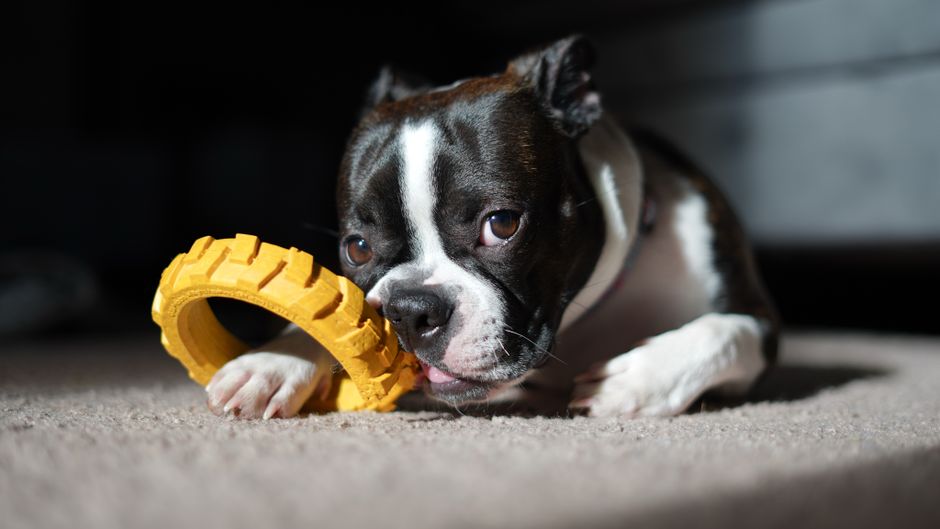
Dogs chew because chewing is built into how they explore the world, relieve stress, and, for puppies, manage the discomfort of teething. It isn't a flaw to be trained out — it's a need to be redirected toward acceptable objects. When chewing becomes "destructive," the object has usually just become more interesting, more available, or more soothing than anything you've offered instead. The fastest way to reduce damage to your belongings is to figure out which of several common drivers is behind it, since a teething puppy, a bored adult dog, and an anxious dog each need a different kind of help.
Puppy Teething vs. Adult Chewing
Puppies chew heavily between about three and six months as adult teeth come in, and chewing on firm objects relieves gum discomfort during this window. This kind of chewing is temporary and resolves largely on its own once teething ends, as long as you supply appropriate outlets in the meantime. Adult dogs who chew destructively are usually responding to something else entirely — understimulation, isolation distress, or a simple lack of management — since the physical need that drives puppy chewing isn't present anymore.
The Main Causes
| Cause | Typical pattern | What helps most |
|---|---|---|
| Teething (puppies) | Chewing on anything textured, gums seem sore | Appropriate chew toys, supervised access, frozen chews |
| Boredom/excess energy | Chewing on random household items, often when active | More exercise, mental enrichment, rotating toys |
| Anxiety/isolation distress | Chewing concentrated near doors or the owner's belongings while alone | Gradual alone-time training, management during absences |
| Lack of management | Chewing happens on items left within reach | Dog-proofing, crate or gated space during unsupervised time |
Reading the Pattern
Where and when the chewing happens tells you a lot. Chewing on your actual belongings — shoes, remote controls, furniture corners — and especially on items that carry your scent can point toward anxiety, particularly if it clusters right after you leave. Chewing on whatever is simply lying around, regardless of whose it is, more often points to boredom or a puppy exploring textures. If the chewing happens only while you're gone and is paired with other signs like barking or scratching at exits, it may be connected to separation anxiety rather than being a chewing problem on its own.
Setting Up for Success
- Puppy-proof or dog-proof the main living space: shoes, cables, and low valuables go out of reach.
- Offer two or three chew toy options with different textures (rubber, rope, firm nylon) and see which your dog prefers.
- Rotate toys every few days so novelty stays high instead of one toy going "stale."
- Use a crate, pen, or gated room during unsupervised stretches until your dog has a reliable habit of chewing only approved items.
- When you catch your dog chewing something inappropriate, calmly swap it for an approved chew rather than just taking the item away.
- Praise or reward your dog when you notice them choosing their own toy over something off-limits.
Enrichment That Actually Reduces Chewing
Frozen stuffed toys, slow feeders, and short daily training sessions all give a dog a legitimate outlet for the same drive that leads to furniture damage. A tired dog with satisfied chewing needs has far less motivation to go looking for something forbidden. This overlaps with other redirect-the-instinct problems like digging, where the solution is also about offering an acceptable version of a natural behavior rather than trying to eliminate the urge itself.
Common Mistakes
- Punishing chewing after the fact. A dog can't connect a scolding minutes later to the act of chewing; it just adds unpredictable stress.
- Giving old shoes or socks as "chew toys." This teaches your dog that shoe-shaped objects in general are fair game, including your current ones.
- Leaving tempting items within reach. Management gaps are the single biggest cause of ongoing destructive chewing in otherwise well-trained dogs.
- Assuming it's "just a phase" without checking for anxiety. Anxiety-driven chewing doesn't resolve with more chew toys alone; it needs its own plan.
- Only offering one type of chew toy. If your dog loses interest, they may look elsewhere out of boredom with the limited options.
- Removing items without a swap. Taking an object away with nothing offered in return leaves the underlying need for something to chew unmet.
Frequently Asked Questions
At what age does puppy teething chewing stop?
Most puppies finish teething and the heaviest chewing urge by around six months, though some individual chewing habits can continue into adolescence if not redirected early.
Is it normal for an adult dog to still chew a lot?
Yes, chewing remains a normal outlet throughout a dog's life. What matters is whether it's directed at appropriate toys or at household items, which usually comes down to management and enrichment.
Should I take the item away immediately?
Yes, but calmly, and always offer an approved chew in exchange so your dog isn't simply left with nothing to satisfy the urge.
Can diet affect chewing?
Diet itself rarely causes destructive chewing, though a vet visit is worthwhile if chewing is unusually intense or paired with eating non-food items, since that can have a medical component.
Sources
- American Kennel Club (AKC) — guidance on puppy teething timelines and appropriate chew toy selection.
- ASPCA — resources on redirecting destructive chewing through management and enrichment.
- American Veterinary Society of Animal Behavior (AVSAB) — position statements favoring reward-based redirection over punishment.