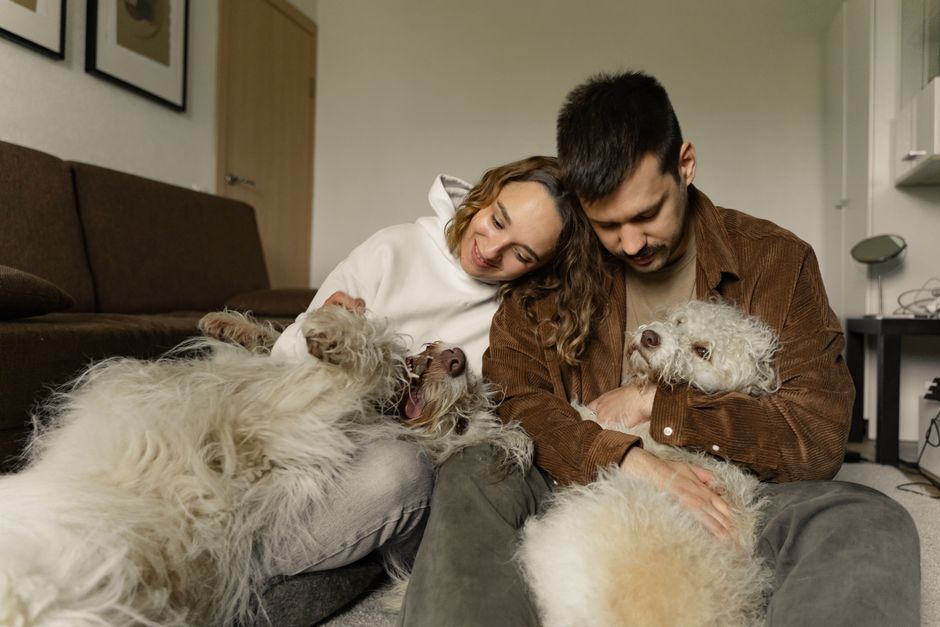
It's a familiar scene in multi-person households: one person lets the dog on the couch, another immediately shoos it off. One person hands over scraps from the table, another scolds the dog for begging. Each person is acting reasonably from their own perspective, but to the dog, the household looks unpredictable, and unpredictability is exactly what slows training down.
Why Dogs Struggle With Mixed Rules
Dogs don't generalize rules the way people do. A person understands that "don't beg at the table" is a household value even if Grandma breaks it on holidays. A dog experiences each person as a somewhat separate set of contingencies: this person reinforces begging, this one doesn't. The result isn't confusion about right and wrong in a moral sense — it's a learning problem. The dog simply hasn't been given consistent enough information to learn one clear pattern, so it keeps testing, because sometimes the behavior pays off.
This connects directly to the trust-building work described in our article on building trust with your dog. Trust depends on predictability, and predictability breaks down fast when the same behavior gets a different response depending on who's in the room.
Where Inconsistency Shows Up Most
Furniture and Space Rules
Couch access, bed access, and off-limits rooms are some of the most commonly contested rules in a household, and dogs notice the pattern of who allows what almost immediately.
Food and Begging
Occasional table scraps from one person can undo weeks of a no-begging routine built by everyone else, because the behavior is still being reinforced, just intermittently.
Greeting Behavior
Jumping on guests is often tolerated by some family members ("it's fine, I don't mind") and corrected by others, leaving the dog without a clear, generalizable rule.
Cue Words and Follow-Through
Using different words for the same cue, or following through on a cue inconsistently, slows down how quickly a dog can learn it reliably.
Building a Shared Household Rulebook
- List the behaviors that matter most right now — usually three to five, not a dozen.
- Agree on one clear response to each behavior, and write it down somewhere visible.
- Agree on the same cue words for the same actions across every household member.
- Check in weekly during the first month to catch and correct drift before it becomes a habit.
- Treat guests and visiting family members as a known variable; brief them before they arrive if a rule matters.
Sample Household Agreement Table
| Behavior | Agreed Response | Who Enforces |
|---|---|---|
| Jumping on guests | Ask for four paws on the floor before attention | Everyone, including guests when briefed |
| Begging at the table | No food from the table, redirect to a mat with a chew | Everyone, no exceptions |
| Couch access | Allowed only when invited with a specific cue | Everyone uses the same cue |
| Door greetings | Sit before the door opens | Whoever answers the door |
Why This Supports Everything Else
Consistency is the practical backbone behind most of the communication skills covered elsewhere in this cluster. A dog that gets a steady, predictable response to its behavior has an easier time offering calming signals and trusting that they'll be respected, and it has more mental bandwidth left over to benefit from mental enrichment rather than spending that energy testing which rule applies today.
Handling Disagreements Before They Reach the Dog
Most household rule conflicts aren't really about the dog at all; they're about two people having different comfort levels with mess, noise, or affection. It helps to separate that conversation from the dog's training entirely. Sit down without the dog in the room, list out the specific behaviors causing friction, and agree on a single version of each rule before reintroducing it. If one person strongly prefers the dog on the couch and another doesn't, a workable compromise — such as allowing it only on a specific blanket, or only after a cue — often satisfies both sides better than an unresolved tug-of-war that the dog ends up caught in the middle of. Revisiting the agreement after a trial period, rather than assuming it has to be permanent, also makes it easier for everyone to buy in, since nobody feels locked into a rule forever.
Common Mistakes
- Assuming the dog will "figure out" different rules per person. Dogs often do learn person-specific patterns, but this takes much longer than a single shared rule and creates ongoing friction.
- Making exceptions "just this once." Occasional reinforcement is often more durable than consistent reinforcement, so rare exceptions can undo a lot of progress.
- Not briefing guests or occasional visitors. A single inconsistent weekend can meaningfully set back a rule the household has been building for weeks.
- Picking too many rules at once. A long list of simultaneous new rules is hard for both the household and the dog to maintain consistently.
- Blaming the dog for inconsistency that originated with people. A dog testing a rule that's inconsistently enforced is behaving logically, not being difficult.
Frequently Asked Questions
How do we get kids in the household to follow the same rules?
Keep rules simple and visual — a short written list on the fridge works well — and have an adult briefly supervise follow-through until it becomes habit for younger family members too.
What if one household member disagrees with a rule?
Talk it through before involving the dog in the disagreement. It's better to compromise on a rule everyone will actually enforce than to have a stricter rule that only some people follow.
How long does it take for consistency to show results?
Many households notice a difference within two to three weeks of genuinely consistent enforcement, though more established habits can take longer to shift.
Does consistency mean never changing a rule?
No. Rules can evolve as a dog matures or circumstances change; the key is that when a rule changes, it changes for everyone in the household at the same time, not gradually or selectively.
Sources
- American Kennel Club (AKC) — guidance on household consistency as a training foundation.
- Certification Council for Professional Dog Trainers (CCPDT) — standards emphasizing consistent, humane reinforcement practices across handlers.
- Humane World for Animals — resources on setting up a supportive, predictable home training environment.
- American Veterinary Society of Animal Behavior (AVSAB) — position statements on the role of consistency in effective, welfare-friendly training.