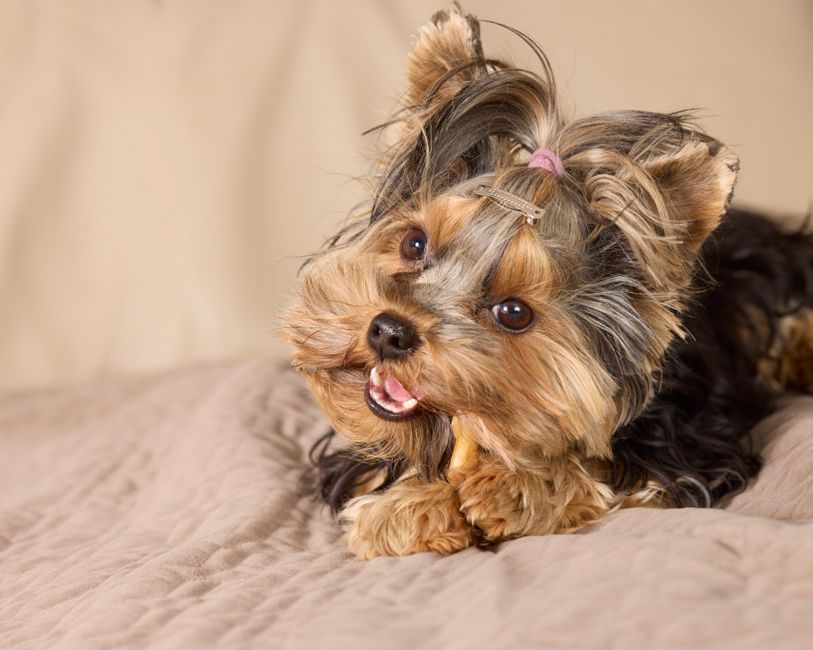
Resource guarding is the instinct to protect something valuable — food, a toy, a resting spot, sometimes even a person — from being taken away. In the wild, that instinct is a survival advantage, and in a pet dog it's a completely normal behavior that exists on a spectrum, from a dog who simply eats a little faster when another dog walks by to a dog who growls, snaps, or bites if approached while holding something they value. The goal with resource guarding isn't to punish the warning signs away; it's to reduce the dog's need to guard in the first place by changing what approaches near valuable items predict.
Recognizing the Early Signs
Resource guarding rarely starts at a bite. It usually begins with subtler signals: freezing over an item, eating faster when approached, a hard stare, lip-licking, or turning the body to block access to a bone or bowl. These early warnings are your dog communicating discomfort before escalating, and responding to them calmly — rather than ignoring them or forcing the issue — is the most effective time to intervene. Growling and snapping tend to appear only after milder signals have been missed repeatedly.
Where Resource Guarding Shows Up
| Context | Typical trigger | Early sign to watch for |
|---|---|---|
| Food bowl | Approach while eating | Freezing, faster eating, stiff posture |
| High-value chews/toys | Someone reaching for the item | Turning away, mouth-covering the item |
| Resting spots (bed, couch) | Someone approaching while dog is settled | Hard stare, low growl, stillness |
| A person | Another dog or person approaching the owner | Positioning between the person and approacher |
Why Punishment Backfires Here
Scolding or physically correcting a dog for growling over a resource teaches the dog that warning signals get punished — not that guarding is unnecessary. Many dogs respond to that lesson by skipping the warning next time and escalating straight to a snap, which is more dangerous for everyone involved, not less. The safer, more effective route is to change what approaching the resource predicts: instead of "someone's coming to take this away," the dog learns "someone approaching means something even better is about to happen."
Safe First Steps
- Stop reaching into your dog's space to "test" guarding or prove you can take things away — this only rehearses the conflict.
- Give your dog space to eat and chew undisturbed, especially around young children and unfamiliar dogs.
- Practice trading up: approach from a distance that doesn't trigger stiffening, toss a higher-value treat near the item, and walk away without taking anything.
- Gradually decrease that distance over many short sessions, always watching for early stress signals and backing off if you see them.
- Teach a reliable "drop it" or "leave it" using trades for something better, never by forcing an item out of your dog's mouth.
- Keep genuinely high-value or novel items (like a real bone) managed and given only in a low-traffic area until trust is built.
Guarding Around People vs. Objects
Guarding a person — positioning between the owner and an approaching dog or person — follows the same underlying logic as object guarding, but is sometimes mistaken for protectiveness or loyalty. It's still an anxiety-driven attempt to control access to something valued, and benefits from the same gradual, trade-based approach rather than encouragement. If guarding behavior overlaps with general fearfulness around people or dogs, it's worth reading our article on fear-based reactivity as well, since the two often share a root cause.
Common Mistakes
- Repeatedly testing the behavior by taking items away. This confirms the dog's fear that approach means loss, making guarding worse over time.
- Punishing growling. It removes the warning signal without addressing the underlying discomfort, which can lead to escalation.
- Forcing a "drop it." Physically prying an item from a guarding dog's mouth is unsafe and reinforces the association between hands and loss.
- Letting children approach dogs with food or toys unsupervised. Even a mild guarder can escalate quickly with a child's unpredictable movement.
- Ignoring mild signs because "it's not a big deal yet." Early signs are the easiest point to intervene; waiting lets the pattern deepen.
- Trying to fix severe guarding without in-person help. Guarding with bite history needs hands-on professional guidance, not a written guide alone.
Frequently Asked Questions
Is resource guarding a sign of a "bad" dog?
No. It's an instinctive response to protect something valued, seen across many species. It reflects anxiety about losing the item, not a character flaw or dominance attempt.
Should I take food away randomly to "show who's boss"?
No, this is one of the most common ways guarding gets worse. It teaches the dog that hands near food mean loss, which increases defensiveness rather than reducing it.
Can resource guarding be fully resolved?
Many mild to moderate cases improve substantially with consistent trade-based training. More severe cases, especially with a bite history, usually need in-person guidance from a qualified professional.
Is guarding more common in rescue dogs?
It can be more common in dogs who experienced food scarcity or competition before adoption, but it also appears in dogs with no such history. Either way, it responds to the same gradual approach.
Sources
- ASPCA — resources on recognizing and safely managing resource guarding in dogs.
- American Veterinary Society of Animal Behavior (AVSAB) — position statements on reward-based approaches to guarding and aggression-adjacent behaviors.
- IAABC (International Association of Animal Behavior Consultants) — guidance on trade-based protocols for resource guarding.
- Fear Free Pets — guidance on reducing stress around food and valued items.