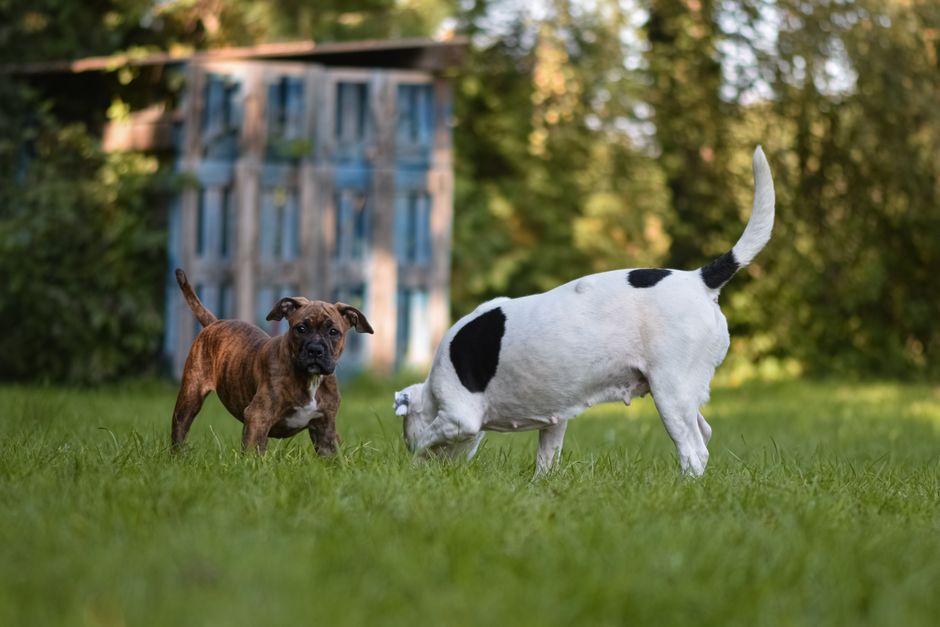
Dog play can look alarming to a new owner watching two dogs body-slam each other at the park. In most cases it's exactly what it looks like — fun, mutual, and self-correcting. But play can also tip into something less mutual, and knowing the difference means knowing what to actually look for, not just how loud it sounds.
Why Play Signals Exist
Play often involves behaviors that look like real conflict — biting, chasing, pinning, growling — borrowed from contexts like hunting or fighting but performed in a softened, exaggerated way. Because these behaviors could be misread as aggression, dogs evolved clear signals to frame the interaction as play rather than something serious. Reading these framing signals is the key skill here.
Common Play Invitations
The Play Bow
Front legs down, rear end up, tail loose and often wagging — the play bow is the clearest, most universally recognized play invitation. It tells another dog "everything that follows is a game."
Exaggerated, Bouncy Movement
Play movement tends to be looser and bouncier than movement used in real conflict or hunting. Dogs at play often move in exaggerated, almost clumsy ways on purpose.
Self-Handicapping
A bigger or stronger dog playing with a smaller one will often deliberately slow down, roll onto its back, or let the smaller dog "win" a chase. This self-handicapping behavior is a strong sign that play is fair and mutual.
Role Reversals and Pauses
Healthy play includes frequent role switching — the chaser becomes the chased, the dog on top rolls to the bottom — along with natural pauses where both dogs briefly disengage, shake off, and often re-initiate with another play bow.
Signals That Play Is Tipping Into Conflict
| Warning Sign | What It Suggests |
|---|---|
| One dog repeatedly pins or chases without role reversal | Play may be one-sided and stressful for the other dog |
| No pauses or self-interruptions over several minutes | Arousal may be climbing without natural resets |
| Stiff, prolonged body-slamming with closed mouths | Possible tension rather than loose, open-mouthed play |
| One dog trying repeatedly to leave and being followed or blocked | Consent has broken down; intervention is needed |
| Growling accompanied by a stiff body and hard stare | Different from the loose, exaggerated growl heard during play |
A Simple Pause-and-Check Routine
- Briefly separate the dogs or redirect attention for a few seconds.
- Watch both dogs' bodies: do they shake off, stay loose, and want to go back in?
- If both dogs re-engage eagerly with loose bodies, play is likely still healthy.
- If one dog hesitates, avoids, or the other immediately escalates again, end the session and separate them calmly.
This pause-and-check habit works well alongside the broader signal-reading skills covered in our guides to tail, ear, and posture cues and dog vocalizations, since play sounds and movements often overlap with more serious signals and the context is what tells them apart.
Play Between People and Dogs
The same principles apply to play between a person and a dog. Letting a dog "win" tug occasionally, watching for self-handicapping in mouthing, and pausing periodically to check whether the dog wants to continue all build the same kind of mutual trust discussed in our article on building trust with your dog.
Toy Play Versus Body Play
Play with toys — tug, fetch, chase-the-ball — tends to have a lower risk of misunderstanding than body-to-body play, simply because the toy absorbs most of the physical intensity. Still, a few of the same rules apply. Watch for a dog that guards the toy with a stiff body and hard stare rather than a loose, bouncy posture; that shift can signal the game has turned from play into resource guarding. With tug specifically, letting a dog win occasionally and pausing briefly between rounds keeps arousal from climbing too quickly, especially with dogs that get overstimulated fast. Fetch can also escalate when multiple dogs chase the same ball; watch for body slamming or snapping near the toy itself rather than at open air, which is a sign the excitement has tipped past a comfortable level for at least one of the dogs involved. As with body play, brief pauses and a quick check of everyone's posture keep toy-based games from sliding into something less mutual.
Common Mistakes
- Assuming growling always means trouble. Play growls are usually looser and higher-pitched, paired with relaxed body language, unlike the stiffer growls heard during real conflict.
- Letting play run on without any pause. Long, uninterrupted sessions can build arousal past the point either dog can self-regulate.
- Ignoring one-sided play patterns. If the same dog is always chasing, pinning, or mounting without reversal, the other dog may not actually be enjoying it.
- Stepping in too late. Waiting for an obvious fight to intervene means missing several earlier, more subtle warning signs.
- Judging play only by noise level. Loud play can be completely healthy, while quiet, stiff interactions can be more concerning.
Frequently Asked Questions
Is it normal for play to look rough?
Yes, especially between dogs of similar size and play style. Roughness alone isn't a red flag; the absence of pauses, role reversal, and loose body language is more telling.
Should I let my dog play with much larger dogs?
It can work well if the larger dog self-handicaps and both dogs show relaxed body language, but supervise closely and be ready to pause the interaction if it becomes one-sided.
What if my dog doesn't seem to want to play with other dogs?
That's okay. Not every dog enjoys group play, and some prefer play with people or solo activities. Forcing social play rarely helps and can increase stress.
How do I safely interrupt play that's escalating?
Call your dog away calmly rather than reaching into the middle of the interaction, and use a cheerful tone rather than a tense one, which can itself raise the temperature of the moment.
Sources
- American Kennel Club (AKC) — resources on healthy dog-to-dog play and socialization.
- ASPCA — guidance on supervising dog play and recognizing when intervention is needed.
- American Veterinary Society of Animal Behavior (AVSAB) — position statements on safe socialization practices.
- International Association of Animal Behavior Consultants (IAABC) — educational materials on canine play behavior.