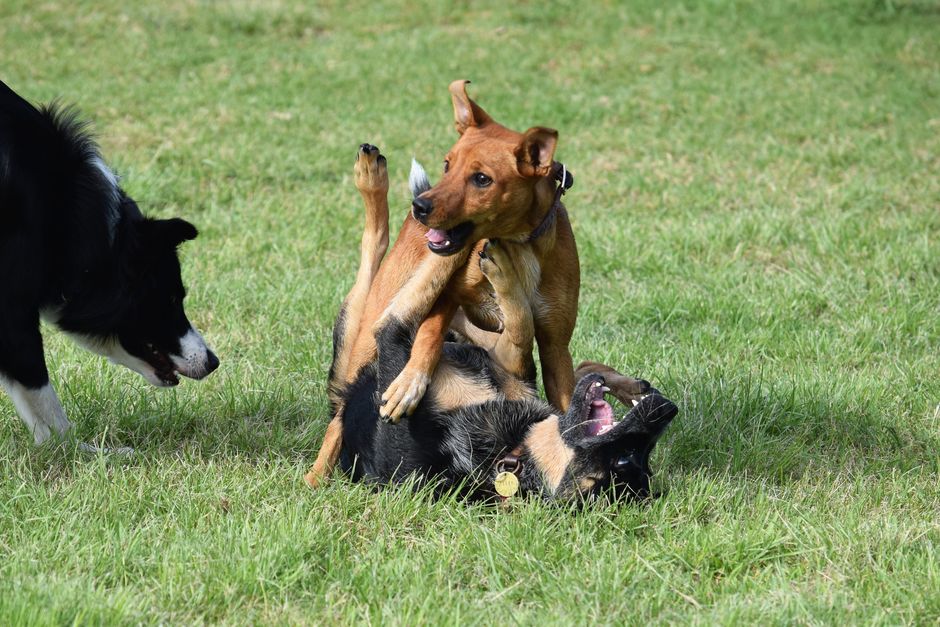
Dog play can look chaotic — growling, body-slamming, mouths wide open around a neck — and still be completely healthy and mutual. The same growling and mouth contact can also be the start of real conflict. The difference usually isn't in any single moment, but in the overall pattern: whether the interaction is balanced, interrupted, and reversible, or one-sided and escalating. This guide breaks down the specific signals to watch for.
Why Body Language Literacy Matters
Knowing the difference between play and conflict lets you intervene calmly and early, rather than either panicking over normal rough play or missing a real warning sign until it's already a problem. This skill matters everywhere dogs interact with other dogs: at home, during first introductions, and especially in group settings like the ones covered in our dog park etiquette and safety guide.
Signs of Healthy, Mutual Play
- Loose, bouncy, exaggerated movements — play bows, bouncing, running in curves rather than straight lines.
- Role-switching: the dog being chased becomes the chaser, the dog on the bottom becomes the one on top.
- Frequent brief pauses, shaking off, or sniffing the ground before diving back in.
- Mouths open and relaxed, often described as a "play face," rather than tightly closed or pulled back.
- Both dogs returning to the interaction voluntarily after a pause.
Play Signals vs. Conflict Signals
| Play | Possible conflict |
|---|---|
| Bouncy, loose, curved movement | Stiff, straight-line movement; frozen pauses |
| Open, relaxed mouth | Tightly closed mouth or lips pulled back showing teeth |
| Roles switch back and forth | One dog is consistently pursuing, pinning, or cornering |
| Tail wagging loosely at a natural height | Tail held very high and stiff, or tucked tightly |
| Both dogs return after a break | One dog tries repeatedly to leave or hide and can't |
The Self-Interrupt Test
One of the simplest ways to check whether play is still healthy is to briefly interrupt it yourself and see what happens.
- Call your dog's name or step between the dogs briefly during a lull in the action.
- Watch whether your dog disengages easily and checks in with you.
- Watch the other dog too — do they also settle, or do they stay fixated and keep pursuing?
- If both dogs settle within a few seconds and seem relaxed, it's generally safe to let them resume.
- If either dog seems unable to settle, is fixated, or the other dog seems relieved by the break, keep them separated for a bit longer.
Early Warning Signs of Trouble
Watch for a sudden, sustained hard stare; a stiff, frozen body; raised hackles along the back; growling that doesn't ease when distance increases; one dog repeatedly trying to escape and being followed or blocked; and any sign that a dog is cornered with no way to leave. These signals are worth acting on immediately rather than waiting to see if they escalate further.
What to Do When You See Warning Signs
Add distance calmly — call your dog away, use a cheerful voice rather than a panicked one, and redirect attention to something else, like a quick walk in a different direction. Avoid grabbing collars in the middle of high arousal, since this can occasionally redirect a bite toward the handler. If tension is a repeated pattern between specific dogs, it's worth stepping back and reconsidering whether that pairing needs a slower, more structured introduction, such as the method in our guide to introducing dogs safely. In a household with more than one dog, repeated tension between housemates is also worth addressing directly — see our article on training tips for multi-dog households for ways to reduce friction over resources and attention.
When a Dog Seems Fearful Rather Than Aggressive
Sometimes what looks like a dog "starting trouble" is actually a fearful dog trying to create distance the only way they know how, including growling or snapping as a last resort. If your dog seems generally anxious or reactive around other dogs rather than simply having one bad interaction, the structured approach in our desensitization and counterconditioning guide is a more targeted next step than general socialization alone.
Common Mistakes
- Assuming all growling means a fight is about to happen. Growling is also a normal part of healthy play for many dogs, especially during tug or wrestling.
- Assuming a quiet, calm-looking dog is automatically fine. A sudden freeze is often a bigger warning sign than noise.
- Letting a one-sided chase continue because "they're still playing." If roles never switch, one dog may not be enjoying it.
- Waiting too long to test the interaction with a quick interrupt. A brief check-in costs almost nothing and tells you a lot.
- Grabbing collars in the middle of a tense, high-arousal moment. This can increase risk to the handler; calm redirection is usually safer.
- Ignoring repeated tension between the same two dogs. Patterns matter more than any single incident.
Frequently Asked Questions
Is growling during play always fine?
Not always, but it's common and often harmless in context, especially paired with loose body language and role-switching. Watch the whole picture, not just the sound.
My dog pins other dogs down during play. Is that a problem?
It depends on whether the other dog seems to accept it and whether roles switch over time. If the pinned dog repeatedly struggles to get away or seems distressed, it's worth interrupting and giving both dogs a break.
How fast should I expect to react to a warning sign?
Within a few seconds. Early intervention — a calm call-away or added distance — is far easier than managing a conflict that's already escalated.
Can two dogs who had one bad interaction ever get along later?
Often, yes, especially with a slower, more structured reintroduction rather than simply trying again under the same conditions. Our guide on introducing dogs to each other safely covers that process.
Sources
- ASPCA — guidance on interpreting canine body language and distinguishing play from conflict.
- American Veterinary Society of Animal Behavior (AVSAB) — resources on recognizing stress and aggression signals in dogs.
- American Kennel Club (AKC) — general guidance on healthy dog-to-dog play behavior.
- IAABC — perspective on early intervention and self-interrupt techniques during dog play.