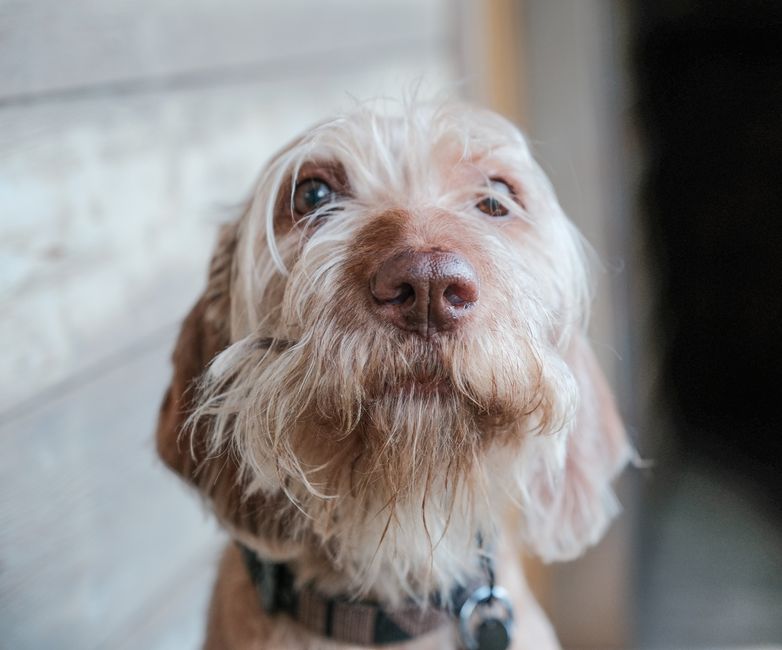
Stress in dogs rarely shows up out of nowhere. There's almost always a sequence of smaller, quieter signals building beforehand, and most owners simply haven't learned to notice them yet. Catching this early stage gives you far more options than waiting until a dog is already overwhelmed, because a dog that's mildly uncomfortable can usually be helped with a small adjustment, while a dog that's fully escalated needs much more space and time to recover.
Why Catching Stress Early Matters
Stress tends to build in stages rather than appearing all at once. A dog typically works through a series of subtler signals before reaching a more obvious reaction, and each stage offers a chance to intervene with less disruption than the one after it. Owners who only recognize the final stage — growling, snapping, bolting — are missing several earlier opportunities to help the dog feel safer with much less effort.
The Escalation Ladder
| Stage | Typical Signals | Best Response |
|---|---|---|
| Early / mild | Lip licking, yawning, slight stillness, ears shifting back slightly | Pause, create a little distance, lower intensity |
| Building | Turning away, sniffing the ground suddenly, whale eye, panting with no exertion | Remove the trigger or significantly increase distance |
| High | Freezing, stiff body, tucked tail, trembling | End the interaction, give the dog a calm space to recover |
| Overwhelmed | Growling, snapping, bolting | Create immediate distance; avoid punishing the signal itself |
This ladder overlaps closely with the subtler calming signals dogs use to self-soothe, and with the broader body language picture covered elsewhere in this library. The difference here is framing: these signals are specifically about rising stress rather than general communication.
Physical Signs Worth Tracking
- Panting that starts suddenly with no heat or exercise involved.
- Shedding more than usual during a specific interaction, which can accompany acute stress.
- Trembling or shaking without cold temperatures present.
- Pacing or an inability to settle in an otherwise familiar environment.
- Loss of interest in food or treats the dog would normally take eagerly.
A Three-Step Response Routine
- Notice the earliest signal rather than waiting for a second or third one to confirm it.
- Reduce whatever is driving the stress — distance, noise, duration, or intensity — rather than pushing through.
- Reassess after a short pause. If the dog's body loosens and signals ease, you can often continue carefully. If not, end the session for now.
Everyday Situations Where This Shows Up
Vet visits, nail trims, crowded sidewalks, loud households, and unfamiliar guests are common settings where early stress signals appear. Interestingly, even play can tip into stress if it isn't monitored, which is covered in more detail in our article on play styles and play signals. Dogs that are chronically under-stimulated also tend to carry a higher baseline of stress, which is one more reason mental enrichment plays a supporting role here.
Keeping a Simple Stress Journal
For dogs that seem to have recurring stress episodes, a short written log can reveal patterns that are hard to spot in the moment. Jot down the date, what was happening right before the signal appeared, which signal showed up first, and how long it took for the dog to settle afterward. Over a few weeks, patterns often emerge: maybe stress consistently builds during a specific time of day, around a particular sound, or during a specific type of handling. This kind of record also makes it much easier to describe what's happening to a veterinarian or a qualified trainer, since vague memories of "sometimes he gets stressed" are far less useful than a concrete list of triggers and responses. Even a simple notes app entry after each notable episode is enough; the goal isn't precision, it's catching a pattern that pure memory tends to miss.
Common Mistakes
- Waiting for growling as the "real" first sign. By that point, several earlier signals have usually already been missed.
- Assuming a quiet, still dog is simply calm. Stillness paired with a stiff body and held breath is often an early high-stress signal, not relaxation.
- Punishing the growl or snap itself. This can suppress the warning signal without resolving the underlying stress, which tends to make the next incident harder to predict.
- Pushing through a stress signal to finish a task. Finishing a nail trim or a greeting despite clear stress signals teaches the dog that signaling doesn't change the outcome.
- Treating every instance of panting as a stress signal. Context matters; panting after exercise or in heat is normal and different from sudden, situational panting.
Frequently Asked Questions
What's the very first sign of stress I should watch for?
It varies by dog, but lip licking, a sudden still posture, or a quick look away are among the earliest and most common signals. Learning your own dog's personal pattern makes this easier over time.
Can stress signals mean something physical rather than emotional?
Yes. Sudden panting, trembling, or restlessness can also indicate pain or illness, so if signals appear without an obvious situational trigger, a veterinary check is a reasonable step.
Is it bad if my dog shows stress signals occasionally?
Not necessarily. All dogs experience mild stress sometimes; what matters is noticing it and responding, not achieving a stress-free life for your dog.
How do I help a dog recover after reaching a high-stress stage?
Give the dog quiet time in a familiar, low-stimulation space, avoid immediately asking for more interaction, and let the dog's own body language guide when it's ready to re-engage.
Sources
- ASPCA — guidance on recognizing and responding to stress in companion dogs.
- Fear Free Pets — resources on the escalation of stress signals and low-stress handling techniques.
- American Veterinary Society of Animal Behavior (AVSAB) — position statements on early recognition of stress and its role in welfare.
- International Association of Animal Behavior Consultants (IAABC) — educational materials on canine stress signaling.